These end-of-year reflections are now a ritual, and I usually commence by reading the previous year’s wrap up. This time, reading last year’s reflection made me laugh because 2025 ended up having twists and turns I could never have anticipated – an important reminder that progress is rarely linear, but that however unexpected, there is always growth, and that’s what matters.
Lab milestones and student wins
I am enormously proud of our lab and all that was achieved this year. Dominic’s thesis was selected for publication in the Journal & Proceedings of the Royal Society of NSW, a prestigious accolade awarded based on scientific excellence and a beautiful capstone to his PhD journey with us. We are grateful to still have him affiliated with our lab, helping with several ongoing projects. Jooya and Sonia both achieved a Class I Honours in the MINDS Lab, and are now headed towards a career in medicine. Our hope is that they carry the MINDS Lab spirit and support into their future clinical careers.
Our teaching and training ecosystem kept expanding. Two Dalyell scholars, Alicia and Hafza, completed their research projects with us, both achieving a high distinction, and Honours students Jooya and Sonia joined a growing cohort of MINDS Lab trainees whose projects are embedded in international collaborations across institutes like McGill, the Max Planck Institute of Psychiatry, the Karolinska and the Lieber Institute for Brain Development. PhD completions and thesis completions continued to roll in, with Helena from the Ooi group successfully obtaining her PhD, Amber doing a stellar job of her final PhD oration, and Katrina, Tamim, Sophie, Lydia and Amber each adding awards, invited talks and new publications to their CVs. We are excited that William Haynes (PhD student) and Yasmine Kostoglou (Lab Manager) joined our team in October. They’ve both already settled right into the MINDS Lab and its hard to imagine what life was like before them! We will also welcome Adeline Blomqvist as an honours student in 2026 – we can’t wait to see what you achieve with the guidance of Sophie!
Conferences, talks and visibility
Conference season once again delivered its signature chaos… the good kind. Tamim and Lydia presented their work at the Australasian Neuroscience Society meeting in Hobart, adding more Tasmanian wind, coffee and networking to the MINDS Lab lore. Three of our PhD students, Amber, Katrina and Tamim, were competitively selected for oral presentations at the international CINP conference in June, and Tamim received the President’s Special Commendation Diploma for his outstanding contributions to neuropsychopharmacology.
Katrina won Best Data Blitz in the PhD category at the SOMS Neuroscience EMCR event, while Sophie secured EMCR travel funding from the Charles Perkins Centre to visit the Lieber Institute later in the year. Throughout 2025, lab members continued to present at national and international meetings, helping to give us visibility in the global stress and neurobiology community and giving our trainees the stage time they richly deserve.
As well as attending my first CINP for a symposium talk in June, I also attended my first ECNP conference in Amsterdam in October, for a Campfire talk with my good friend and colleague Associate Professor Thora Halldorsdottir from the University of Reykjavik. It really was unlike any other talk we’ve given. We had a great time presenting and catching up with friends and mentors, followed by a collaborative visit for NeSTED at the Karolinska Institute with Drs Cristiana Cruceanu and Pablo Lopez. Combined with several invited talks across Australia, and presenting the Aubrey Lewis Plenary at BPA, it is always an honour to promote our lab’s work and the excellence of our lab members.
TRIP, brain donation and global collaborations
I am delighted that our TRIP refugee project with STARTTS this year moved from concept to tangible progress, with pilot data now in hand and the STARTTS team presenting an abstract at the 4th Australia and New Zealand Refugee Trauma Recovery in Resettlement (STARTTS x FASSTT) Conference next year. Collecting these data has involved deep collaboration with clinicians, community organisations and refugee families, and every dataset we add feels like a step toward more compassionate, biologically informed care.
In August, Katrina and Sophie travelled to the Lieber Institute for Brain Development in Baltimore, where they spent time with Prof Thomas Hyde and Prof Joel Kleinman’s teams, and observed firsthand how the world’s largest repository of human brain tissue for neuropsychiatric research is curated and cared for. The experience brought home the enormity of brain donation as a gift, and it was particularly moving given that the tissue we use in our own experiments is derived from that same repository.
Networks and leadership
September brought a different kind of spotlight when Sophie attended the University of Sydney’s “For Good” 175-year campaign celebration at the Sydney Town Hall on behalf of the lab. Over the course of the evening she moved from table to table, sharing stories about our work with alumni, philanthropists and community leaders, translating single-cell data and spatial maps into conversations about people, trauma, resilience and hope.
Our NeSTED consortium continued to gather momentum, with our 2025 virtual symposia bringing together trainees across Sydney, the Max Planck Institute, the Karolinska Institute and Reykjavik University for a program of talks and discussions that felt both rigorous and fun. Within USYD, the lab’s contributions to spatial biology continues to grow into capacity-building efforts, positioning our group as a key part of the next wave of spatial multiomics infrastructure and training.
Time to rest
Threaded through all of these achievements is a quieter story of culture: people showing up for each other in the lab, at seminars and conferences, and in zoom and slack channels across time zones. Another year of weekly lab meetings, journal clubs, supervision sessions, the many international collaborator meetings late at night or at the crack of dawn, our hallway discussions and coffees. These might not make headlines, but they are the scaffolding that holds everything else together. This year, those structures allowed students and postdocs to take brave steps, giving their first international talks, travelling to new countries for training and learning, engaging with our international network or telling their science to a room of strangers in black-tie. Our lab family is always firmly in every member’s corner.
So as the bow draws back again at the end of 2025, it feels less like tension and more like gathering potential energy. Whatever direction the arrow flies next year, it will be propelled by the collective effort, courage and kindness of this remarkable group of humans in the MINDS Lab, and that is something worth celebrating.
From our “lab” family to you and yours, Happy Holidays and may the New Year feel happy and light.
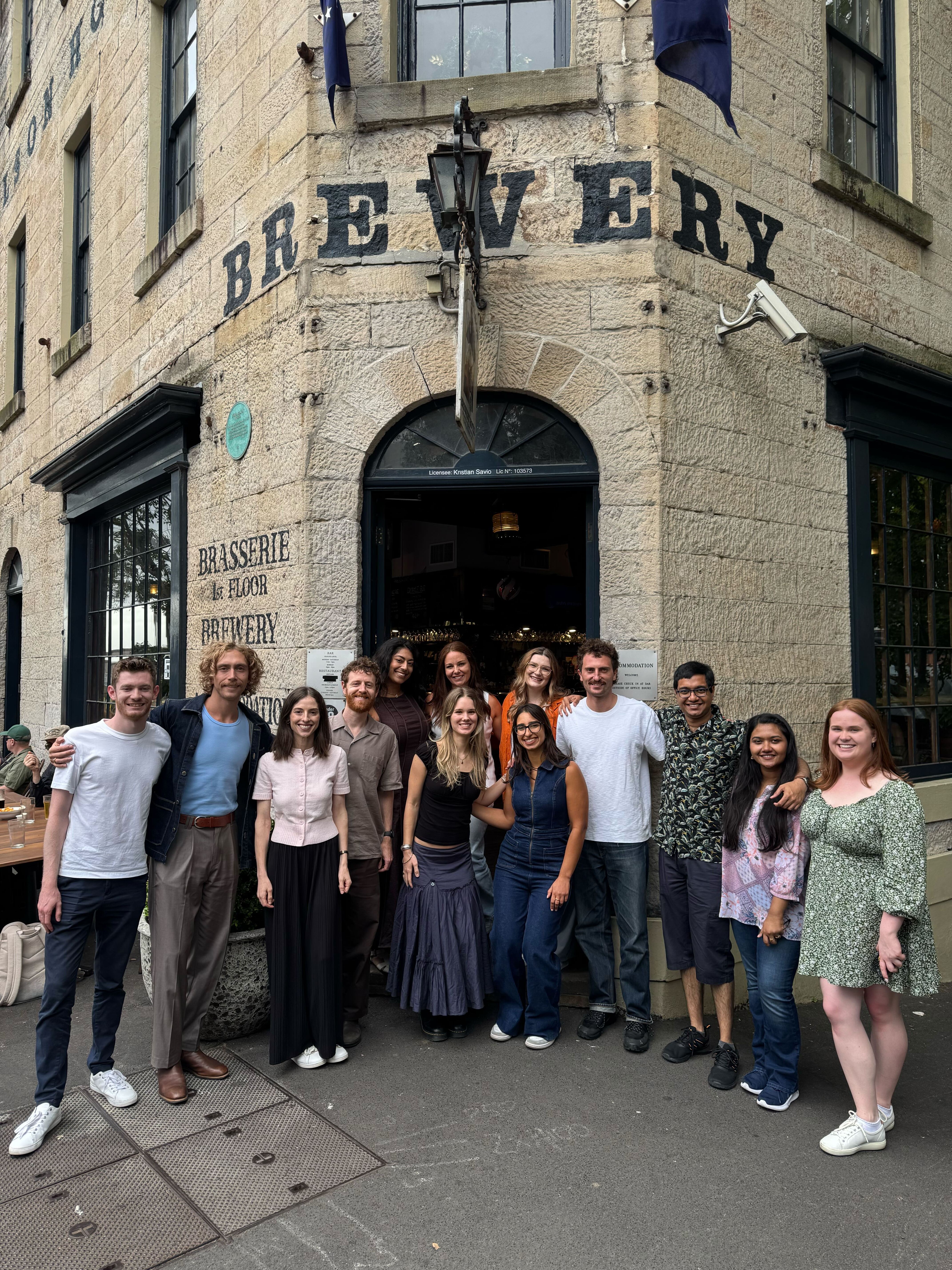
Some MINDS Lab Highlights
- Dominic’s PhD thesis selected for publication in the Journal & Proceedings of the Royal Society of NSW.
- Jooya Kalantar and Sonia Hoang were awarded Class I Honours.
- PhD student Tamim Ahsan received the President’s Special Commendation Diploma from the College of International Neuropsychopharmacology (CINP).
- PhD students Amber Curry, Katrina Edmond and Tamim Ahsan were competitively selected for oral presentations at the CINP international conference.
- Tamim also was selected for an oral presentation at the Australasian Neuroscience Society conference in Hobart, where our postdoc Dr. Lydia Hardowar presented a poster.
- Drs Lydia Hardowar and Sophie Debs were the first in Australia to establish the 10x Genomics Visium HD 3’ platform. Their resulting images were selected to be included in the Millenium Sciences APAC Visium HD 3′ Art Gallery: Canvas of Life’s Spatial Beauty program.
- PhD student Katrina Edmond won Best Data Blitz (PhD category) at the Sydney School of Medical Sciences Neuroscience EMCR Data Blitz.
- Postdoc Dr Sophie Debs received EMCR Travel Funding from the Charles Perkins Centre to undertake an internship at the Lieber Institute for Brain Development, with Katrina.
- Natalie was awarded the Aubrey Lewis Award from Biological Psychiatry Australia, and commenced as Vice President of the Society in October.
2025 Publications:
- Kaul D, Curry AR, Gerstner N, Fröhlich AS, Krontira AC, Kyrousi C, Smith CC, Sutherland GT, Dottori M, Ziller MJ, Chatzinakos C, Daskalakis NP, Cappello S, Czamara D, Binder EB, Cruceanu C, Knauer-Arloth J, Mechawar N, Schwab SG, Ooi L, Matosin N. Astrocytic glutamate regulation is shaped by adversity and glucocorticoid signalling. BioRxiv, 2025.
- Edmond KZ†, Kaul D†, Yusupov N† (†joint first-author), Rao R, Jaffe AE, Kleinman JE, Weinberger DR, Hyde TM, Czamara D, Binder EB*,Matosin N*(joint senior-author). Age-Dependent DNA Methylation changes at FKBP5 enhancer sites drive increased gene expression in schizophrenia. BioRxiv, 2025.
- Debs S and Matosin N. Unlocking the Molecular Secrets of the Human Habenula. American Journal of Psychiatry 182(11), 960-962, 2025 [IF=15]
- Edmond KZ, Matosin N. Expanding our understanding of (mal)adapted stress physiology in psychiatric disorders: achieving single-cell characterisation of steroids and neuropeptides. Neurobiology of Stress 100739, 2025 [IF 4.3].
- Worf K† & Matosin N† (†joint first-author), Gerstner N, Fröhlich AS, Koller A, Degenhardt F, Thiele H, Rietschel M, Udawela M, Scarr E, Dean B, Theis FJ, Knauer-Arloth J†, Mueller NS†. Exon-Variant Interplay and Multi-Modal Evidence Identify Endocrine Dysregulation in Severe Psychiatric Disorders Impacting Excitatory Neurons. †equal contributions. Translational Psychiatry 15 (1), 153 [IF=5.8]
- Gerstner N, Froelich AS, Matosin N, Gigliardi M, Cruceanu C, Koedel M, Rex-Haffner M, Tu X, Mostafavi S, Ziller M, Binder EB, Knauer-Arloth J. Contrasting genetic predisposition and diagnosis in psychiatric disorders: a multi-omic single-nucleus analysis of the human OFC. Science Advances 11,eadq2290, 2025. [IF=11.1]
- Hill RA, Bastawy EM, Berk M, Brown RM, Burne TH, Chesworth R, Clark SR, Clemens KJ, Cui X, Dunn AL, Eratne D, Foldi CJ, Gatt JM, Gubert C, Gurvich C, Hannan AJ, Harms L, Hill-Yardin EL, Jaehne EJ, Jawahar MC, Jones NC, Kang M, Karl T, Kesby JP, Kim JH, Lawrence AJ, Macpherson H, Manning EE, Matosin N, Namipashaki A, Nithianantharajah J, Pantelis C, Perry CJ, Petty AE, Purves-Tyson TD, Renoir T, Sarnyai Z, Shaam al abed A, Spark D, Toben C, Todd J, Tye SJ, Weston-Green K, Walder K, Sundram S. Of mice, molecules and mental health: Establishment of the Consortium for Preclinical Psychiatric Research to find solutions to the translational gap in psychiatric research. Accepted 3/10/2025, Molecular Psychiatry. [IF=10.1]


