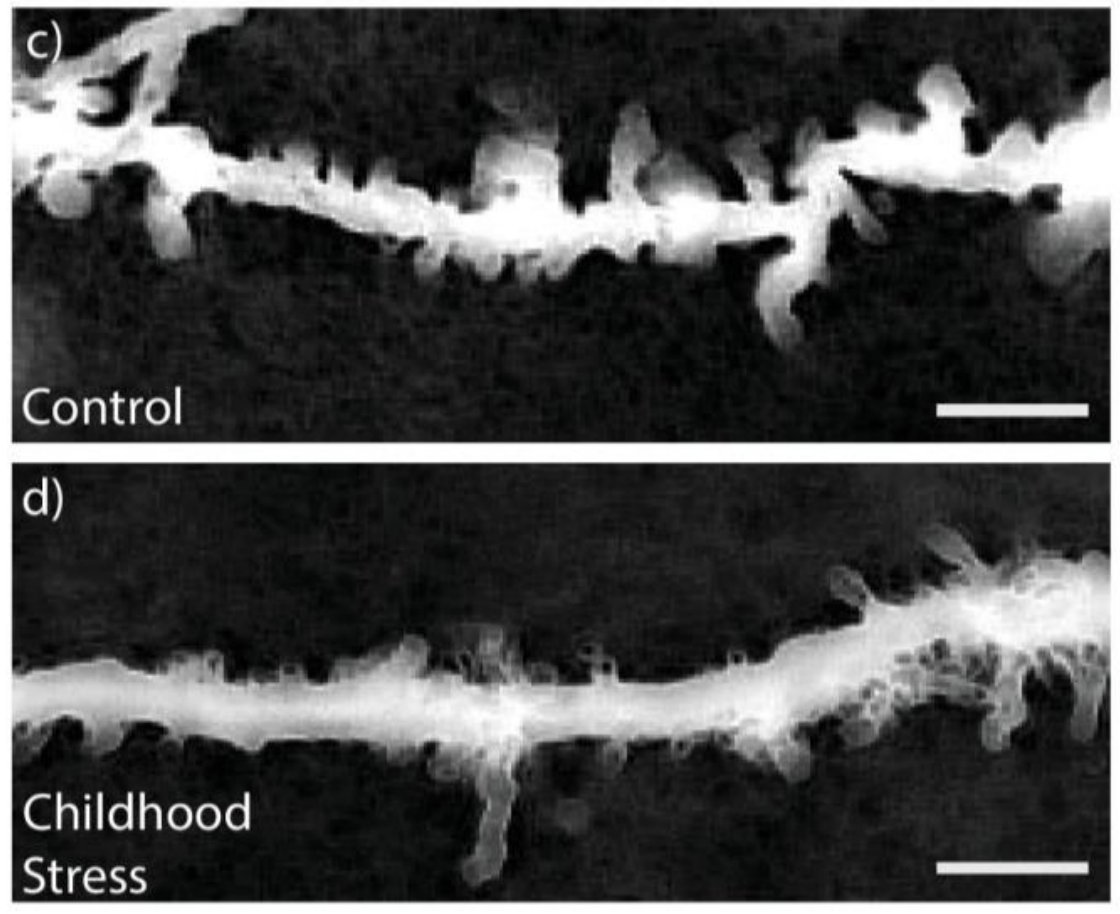
We found that severe stress, in childhood or adulthood, persistently affects the fine morphological properties of neurons in the human cortex of ppl with mental illness – and this is exacerbated after childhood vs adult stress
Let me tell you more
(picture not anatomically correct)
Dominic performed Golgi Cox staining and manually measured the morphology and density of over 22,000 dendritic spines on layer-specific pyramidal neuron apical dendrites.
You heard me. Manually. Measured. 22,000. Structures 🤯 go Dominic
We also measured glucocorticoid receptor mRNA and protein, the main cortisol stress hormone receptor, as a marker of stress dysregulation.
Both childhood and adulthood stress were associated with *striking* reductions in mature [mushroom] spine density (up to 56%!!! loss). But it was childhood stress that caused the most substantial reductions to both total and mature spines.
Here’s a picture demonstrating the spine changes. Top, control, bottom, childhood stress. These spine changes also correlated with the levels of glucocortioid receptor mRNA and protein.
Now friends, we found these childhood stress effects in people who died as adults… suggesting that the effects of stress on the dendritic spines of pyramidal cells from childhood persist over the life course
Dendritic spines are 1-10μm protrusions from neuronal dendrites (brain cell fingers). They are sites of several essential postsynaptic proteins and neurotransmitter/ hormone receptors. So if these guys are disrupted, we have big problems for cellular connections and signalling
This means that reduced spines in the OFC *could* be involved in impaired emotional regulation and anxiety associated with psychiatric disorders. And maybe these structural changes in childhood are setting people on a trajectory to develop mental illness later in life
Huge thanks to Dominic for spearheading the project, especially all your hard labour, and all our awesome collaborators. Also thanks to the Rebecca L Cooper Medical Research Foundation for funding this beauty.
Natalie Matosin is a brain biologist interested in how stress and trauma contribute to the development of mental illness.
View all posts by Dr Natalie Matosin