And just like that, my daughter turns one, a year of maternity leave is over and I’m back in action. Extremely grateful for the privilege of spending the last year with my kids, and now very happy to be back doing what I love, and for all the exciting times ahead for the MINDS Lab in 2022.
Among those exciting things is the expansion of our group!
We are welcoming two new members to our lab, Honours students Katrina Edmond (Bachelor of Science, Hons) and Jyi Den Boogert (Bachelor of Medical Biotechnology, Hons). Katrina will be working on an in-depth histological characterisation of stress-related genes in the brain, while Jyi will be working on understanding how stress impacts the blood-brain-barrier in psychiatric disorders. So excited to welcome them both to the team.
Also a huge congratulations to Katrina who was awarded the De Dominicis Foundation Health and Medicine Honours Scholarship. The scholarship was established in 2021, by Robert De Dominicis, and provides $5,000 to a student entering their Honours year of a degree in health and medical research, to support their Honours journey. Thoroughly deserved and what a wonderful way to start the year!
I’m so excited to share that Amber Curry has won a competitive 2021 University Postgraduate Award to undertake her PhD in our lab from Sept 1. Amber just finished her Honours project with us in June, which she blew out of the water, developing new techniques, topping her cohort and scoring a first class honours! For her PhD, Amber is going to be continuing her Honours work into understanding how stressful experiences early in life affect the molecular makeup and cellular landscape of the hippocampus, a deep brain structure which is typically known for its role in memory. Can’t wait to see what you find, Amber, and congratulations on your PhD scholarship!
We have a PhD scholarship available to start by March 2023, to study the effects of stress on the brain (human postmortem) in the context of severe mental illness, using histology and single-cell omics. The project will be based in beautiful Wollongong, Australia, as part of an international research team that spans USA, Germany and Canada.
Please find more information about the position in the document below, including the application process. Applications will be accepted until November and shortlisted applicants will be contacted to interview.
Congratulations to Dominic Kaul for publishing his first review paper in Neuroscience and Biobehavioural Reviews. Dominic presents strong evidence of how stress exposure can physically reshape the brain, with a comprehensive review of macro/micro-structural data from animals and humans. He also provides the first in-depth discussion of cell-type specific impacts of stress on the brain. It is really a great review, we hope you enjoy it too. Congratulations again, Dominic!
We found that severe stress, in childhood or adulthood, persistently affects the fine morphological properties of neurons in the human cortex of ppl with mental illness – and this is exacerbated after childhood vs adult stress
Let me tell you more
(picture not anatomically correct)
Dominic performed Golgi Cox staining and manually measured the morphology and density of over 22,000 dendritic spines on layer-specific pyramidal neuron apical dendrites.
You heard me. Manually. Measured. 22,000. Structures 🤯 go Dominic
We also measured glucocorticoid receptor mRNA and protein, the main cortisol stress hormone receptor, as a marker of stress dysregulation.
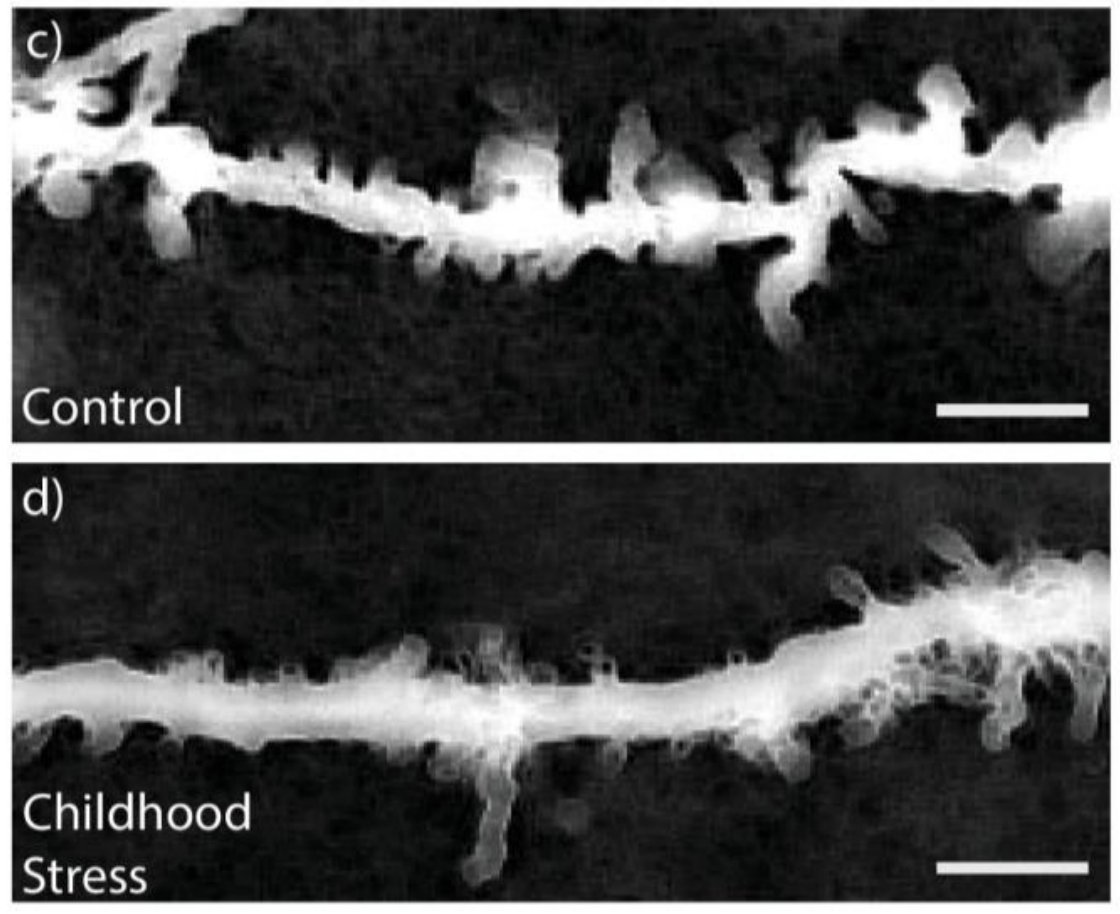
Both childhood and adulthood stress were associated with *striking* reductions in mature [mushroom] spine density (up to 56%!!! loss). But it was childhood stress that caused the most substantial reductions to both total and mature spines.
Here’s a picture demonstrating the spine changes. Top, control, bottom, childhood stress. These spine changes also correlated with the levels of glucocortioid receptor mRNA and protein.
Now friends, we found these childhood stress effects in people who died as adults… suggesting that the effects of stress on the dendritic spines of pyramidal cells from childhood persist over the life course
Dendritic spines are 1-10μm protrusions from neuronal dendrites (brain cell fingers). They are sites of several essential postsynaptic proteins and neurotransmitter/ hormone receptors. So if these guys are disrupted, we have big problems for cellular connections and signalling
This means that reduced spines in the OFC *could* be involved in impaired emotional regulation and anxiety associated with psychiatric disorders. And maybe these structural changes in childhood are setting people on a trajectory to develop mental illness later in life
Huge thanks to Dominic for spearheading the project, especially all your hard labour, and all our awesome collaborators. Also thanks to the Rebecca L Cooper Medical Research Foundation for funding this beauty.